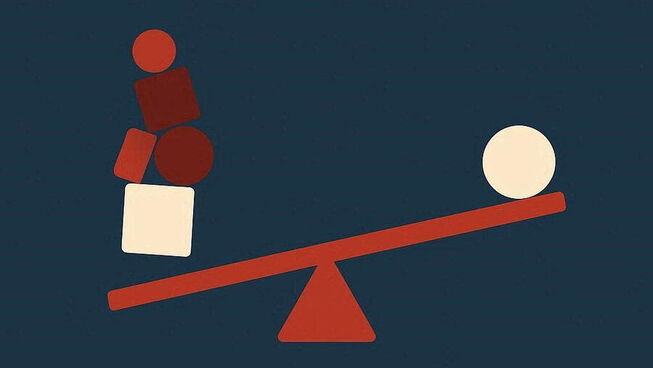
There are subtle and not-so-subtle ways that I try to push past my limits.
Smashing my third or fourth coffee to power through the mid-afternoon slump.
Skipping lunch breaks to squeeze more into my day.
Putting in 10+ hour workdays or burning the midnight oil to get more done.
Overcommitting and biting off more than I can chew.
Saying yes to taking on additional responsibilities to add to an already full plate.
Thinking that I could accomplish more, if only I had more time and energy.
These patterns point to striving to achieve or do more by overcoming my physical or mental limits.
I am reminded soon enough that going beyond my limits can only last for so long. There comes a point that not even another coffee can get the neurons in my brain firing when I am sleep deprived. If I try to push my limits for long enough, eventually my brain short circuits or my body crashes.
I actively fought my limits in a cycle of churn and burn for years in a demanding corporate job at a company with a high-performance culture. It took another cycle of burnout for me to come to the realisation that conquering my limits was unsustainable and required a step change to break the cycle. For me, that meant stepping off the treadmill of a promising career trajectory at my previous company that I worked at for over a decade to taking on a less demanding job at a much smaller organisation.
Is there a better way than to constantly battle your limits? Is there an alternative narrative to that of seeing limits as deficiencies that inhibit you from achieving your full potential?
1. Acknowledge your limits
Acknowledge your limits to your capacity, energy and time, and how these fluctuate with different seasons of life.
I have come to terms that my days of boundless energy and high capacity are probably behind me. Gone are the days where I could bounce back quickly after a late night or when my available time is matched by available energy. The increasing number of white hairs on my head remind me that I am physically aging. A recent conversation with friends who are also in their mid-to-late thirties involved debating as to whether we would be classified as middle age. Time seems to slip through my fingers through each passing year.
There is grief in mourning the reduction in our capacity and energy that comes with age. I think back wistfully to my twenties when I had the capacity to be very actively involved in multiple ministries at church, run half marathons, work long hours in a demanding job, travel regularly and still maintain a social life.
What if limitations aren’t weaknesses that we fight but rather something we can graciously accept?
There is a sentence in the Bible I think is really helpful. "Teach us to number our days that we may gain a heart of wisdom" (Psalm 90:12). We won’t live forever. Our days are numbered. Our mortality could be the ultimate limitation - or it could be what helps us to live wisely and well in this world.
2. Flip the script and reframe your limits
“Finitude is an unavoidable aspect of our creaturely existence – you’re only human” Kelly M. Kapic
When I experienced a physical injury, it became a crash course in managing and navigating physical limitations. Breaking my ankle was a humbling experience as it meant that I had to rely on others to open doors, drive me around and carry things for me whilst I was crutches for weeks. I needed a physiotherapist to train me to build the strength and mobility to be able to walk properly again. I quickly learned that being physically incapacitated meant living with a level of helplessness with the loss of some independence. However, being dependent on others meant that I experienced the kindness of others who were willing to act as my hands and feet for me.
Our limits are what make us human. Limits are not deficiencies or weaknesses in our design but rather we are wired in a way that means that we need other people. We were made for community and connection with others. And as a follower of Jesus I would also argue that we are made for dependency on God and relationship with him.
Coming to terms with my creaturely human limits for me looks like no longer looking inwards and resenting my limitations. Embracing my God-given limits encourages me to look outwards to connect with others and asking for help in my neediness and looking upwards to Him upon whom my very existence depends on.
"I praise you, for I am fearfully and wonderfully made." – Psalm 139:14
Reflection Questions
1. What is a mental or physical limit for you in this current season of life?
2. What are ways in which you try to overcome or fight your limits?
3. What would it look like to embrace your limits?